Harvard Study: Moon Water Reserves Support 10,000 Residents, Not Millions
Researchers calculate that current lunar water estimates sustain a small town for centuries, but a million-person city would run dry in a century.
By Fatima Laurent ·
A population of one million residents could sustain itself on the lunar surface for only about 100 years, according to a new analysis published in the journal Frontiers in Space Technologies.
Martin Elvis, a senior astrophysicist at Harvard University's Smithsonian Astrophysical Observatory, and Jonathan McDowell, an honorary professor at the Durham University Space Research Centre, conducted the study. Their work responds to recent statements by technology leaders regarding lunar colonization. In February, Elon Musk, CEO of SpaceX, stated that the company was shifting its focus to building a self-growing city on the moon, a project he estimated could be completed in under 10 years. Jeff Bezos, CEO of Blue Origin, previously claimed that millions of people would live in space by 2045.
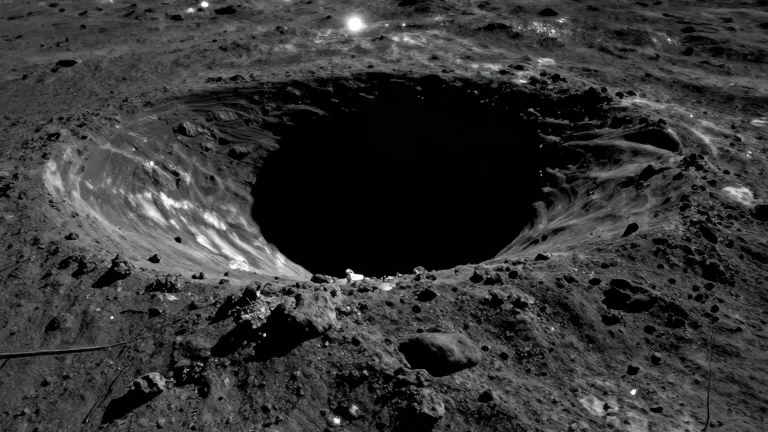
The researchers examined two critical resources: power and water. They determined that solar and nuclear energy sources would be sufficient to support one million people. Water availability presented a more complex challenge. Current estimates suggest the moon holds roughly one billion tonnes of water, primarily located in permanently shadowed polar regions. The study assumes a 98 per cent water recycling rate, matching the standard achieved on the International Space Station.
Elvis described the total water supply as modest. He compared the volume to an aquarium the size of Central Park filled until the Statue of Liberty is just underwater. "It's a small lake," Elvis said, "and a small lake is not going to supply a big city for very long." Under these assumptions, a settlement of 10,000 people would remain sustainable for centuries.
McDowell noted that larger cities would require new methods to acquire water. "If you want to cover the face of the moon with cities, like in the best science fiction, then you have to find a way to get the water there, because it's not there right now," he said.
The researchers acknowledged that their initial figures may be optimistic. Elvis estimated that the one-billion-tonne figure is likely 20 to 30 times too high, with only one-third to one-half of the water being recoverable. He suggested that the actual usable amount is about one per cent of the original estimate, which would reduce the lifespan of a million-person city from 100 years to one year.
Gordon Osinski, a professor of planetary geology at Western University in London, Ontario, pointed out that the physical state of the water remains uncertain. Satellite measurements carry uncertainties, and the water may exist as sub-millimetre ice crystals mixed into soil, similar to Arctic permafrost. McDowell argued that the findings provide clarity rather than discouragement. "The truth is never negative," he said. "What's negative is to actually go and try and do something that isn't going to work."
Source: CBC News